
Google Ads vs Meta Ads: What’s the Difference?
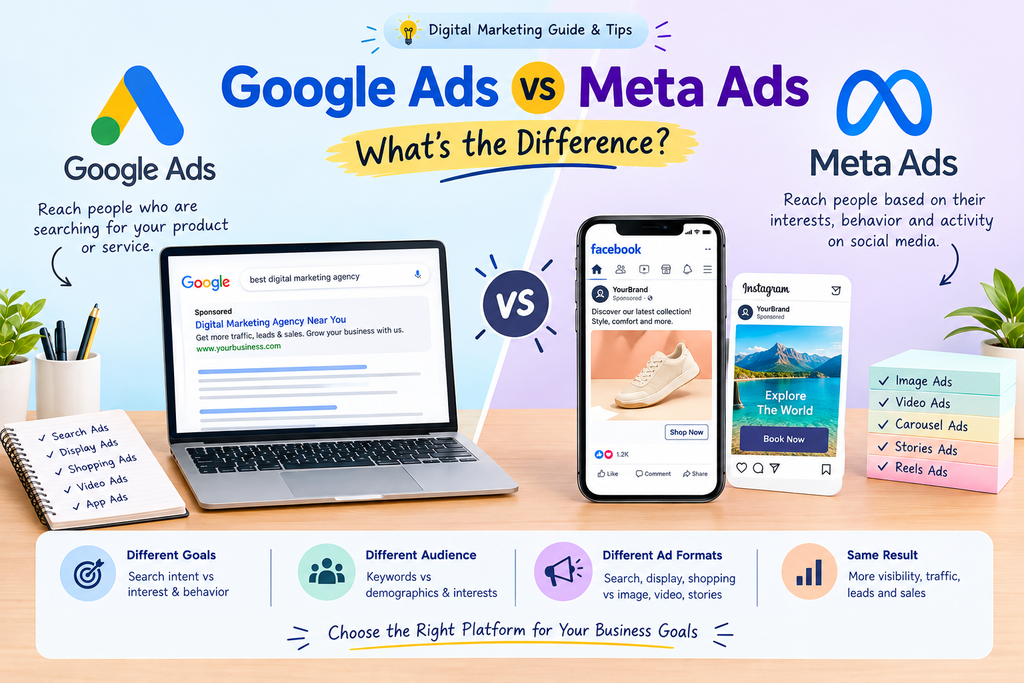
Online advertising has become an important part of digital marketing. Businesses use paid advertisements to reach potential customers, promote their products or services, increase website traffic, generate leads, and make sales. Two of the most popular advertising platforms are Google Ads and Meta Ads.
Although both platforms are used for online advertising, they work in different ways. Google Ads mainly helps businesses reach people who are actively searching for something, while Meta Ads helps businesses reach people based on their interests, behavior, demographics, and activities on social media.
Understanding the difference between Google Ads and Meta Ads can help businesses choose the right platform for their marketing goals.
What Are Google Ads?
Google Ads is an online advertising platform from Google. Businesses can use it to display advertisements across Google’s advertising network.
One of the most common forms of Google Ads is Search Ads. These advertisements can appear when people search for specific keywords on Google.
For example, imagine you own a digital marketing agency and someone searches for “digital marketing agency near me.” Your business can use Google Ads to show an advertisement to people searching for services related to that keyword.
Google Ads can also include other types of advertising, such as display ads, shopping ads, video ads, and app campaigns.
The main idea behind Google Ads is to reach people when they are searching for information, products, or services.
What Are Meta Ads?
Meta Ads are paid advertisements that businesses can create through Meta’s advertising system. These ads can appear on platforms such as Facebook and Instagram, depending on the campaign setup and placements selected.
Unlike Google Search Ads, people do not usually need to search for a product before seeing a Meta Ad.
For example, if someone is interested in fitness, clothing, travel, or digital marketing, they may see advertisements related to those interests while using Facebook or Instagram.
Businesses can use Meta Ads to promote products, services, websites, apps, content, offers, and more.
Google Ads vs Meta Ads: The Main Difference
The biggest difference between the two platforms is user intent.
With Google Ads, people often search for something because they already have a need or interest. For example, someone searching for “buy running shoes online” may already be interested in purchasing running shoes.
With Meta Ads, businesses can reach people based on different targeting signals even when they are not actively searching for a product. For example, a person interested in fitness may see an advertisement for running shoes while scrolling through Instagram.
In simple words:
Google Ads = Reach people who are searching.
Meta Ads = Reach people based on interests, behavior, and audience targeting.
Difference in Audience Targeting
Both platforms provide targeting options, but their approaches are different.
Google Ads can use factors such as keywords, location, language, device, audience signals, and other campaign settings depending on the campaign type.
Meta Ads provides detailed audience-targeting options based on factors such as demographics, interests, behaviors, custom audiences, and lookalike audiences where available.
For example, a clothing brand can use Meta Ads to target an audience interested in fashion and online shopping.
Google Ads can be particularly useful when people are actively searching for products or services related to a business.
Difference in Advertising Formats
Google Ads offers several advertising formats depending on the campaign.
These can include:
- Search Ads
- Display Ads
- Shopping Ads
- Video Ads
- App Ads
Meta Ads also offers different formats, including:
- Image Ads
- Video Ads
- Carousel Ads
- Story Ads
- Reels Ads
This makes both platforms useful for different types of campaigns.
Google Ads vs Meta Ads: Cost
The cost of advertising depends on many factors, including the industry, competition, audience, location, campaign objective, ad quality, and bidding strategy.
Google Ads often works well for businesses targeting specific search terms where people have a strong intention to find a product or service.
Meta Ads can be useful for reaching a broader or interest-based audience and generating awareness, engagement, leads, or sales.
There is no fixed answer about which platform is always cheaper. The actual cost depends on the campaign and how effectively it is managed.
Which Platform Is Better for Brand Awareness?
If your main goal is brand awareness, Meta Ads can be a strong option because businesses can show visual content to people while they are using social media.
For example, a new clothing brand can use attractive images or videos on Instagram and Facebook to introduce its products to potential customers.
Google Ads can also support brand awareness, especially through display and video campaigns, but its biggest strength is often reaching people with a specific search intent.
Which Platform Is Better for Getting Leads?
Both Google Ads and Meta Ads can be used for lead generation.
Google Ads can be useful when potential customers are actively searching for a service. For example, a person searching for “best home tutor in Delhi” may be interested in contacting a tutor.
Meta Ads can also generate leads by showing advertisements to selected audiences and directing them to a website, landing page, or lead form.
The better choice depends on the business, target audience, offer, and campaign strategy.
Which Platform Is Better for Sales?
Both platforms can help businesses generate sales.
Google Ads can be especially useful for products or services that people actively search for. For example, an online store selling laptops can target searches related to buying laptops.
Meta Ads can be effective for visually attractive products because businesses can use images, videos, Reels, and carousel ads to showcase products.
For e-commerce businesses, using both platforms together can sometimes be useful.
Advantages of Google Ads
Google Ads has several advantages:
High Search Intent: You can reach people who are actively searching for a product or service.
Keyword Targeting: Search campaigns can target relevant search terms.
Different Ad Formats: Businesses can use search, display, shopping, video, and other campaign types.
Measurable Results: Businesses can track clicks, conversions, costs, and other performance metrics.
Quick Visibility: Paid ads can provide visibility on search results without waiting for organic SEO rankings.
Advantages of Meta Ads
Meta Ads also provide several benefits:
Detailed Audience Targeting: Businesses can target audiences using various demographic and interest-based options.
Visual Advertising: Images, videos, Stories, and Reels can help businesses present products creatively.
Large Social Media Reach: Businesses can reach users across Meta’s advertising placements.
Brand Awareness: Meta Ads can help introduce new products and brands to potential customers.
Retargeting: Businesses can use available audience tools to reconnect with people who have previously interacted with their business.
Google Ads or Meta Ads: Which One Should You Choose?
There is no single platform that is best for every business.
Choose Google Ads when your customers are likely to search for your product or service on Google. It can be particularly useful for search-driven businesses such as local services, professional services, repair services, and businesses with products that people actively search for.
Choose Meta Ads when your goal is to build awareness, reach specific audiences, showcase visual products, generate leads, or promote content on social media.
For example, a local plumber may benefit from Google Search Ads because people often search for plumbing services when they need them. A fashion brand may benefit from Meta Ads because clothing can be promoted effectively through visual content on Instagram and Facebook.
Can You Use Google Ads and Meta Ads Together?
Yes. Businesses can use both platforms as part of the same digital marketing strategy.
For example, a business could use Meta Ads to introduce its products to a new audience and create awareness. Later, Google Ads can help reach people who are actively searching for that product or service.
Using both platforms can help a business reach customers at different stages of the buying journey.
However, businesses should not automatically use both platforms without a clear strategy. It is important to understand the target audience, marketing goals, budget, and campaign performance first.
Simple Example
Imagine you have an online business selling skincare products.
You could use Meta Ads to show attractive skincare videos and product images to people interested in skincare and beauty.
At the same time, you could use Google Ads to target searches such as “buy face moisturizer online” or other relevant search terms.
The Meta campaign can help create interest, while Google Search Ads can help reach people who are actively looking for a product.
Google Ads vs Meta Ads: Quick Comparison
| Feature | Google Ads | Meta Ads |
|---|---|---|
| Main Platforms | Google Search and Google advertising network | Facebook, Instagram and Meta placements |
| Main Strength | Search intent | Audience and interest targeting |
| Common Goal | Leads, sales, website traffic | Awareness, engagement, leads, sales |
| Common Formats | Search, Display, Shopping, Video | Image, Video, Carousel, Stories, Reels |
| Best For | People actively searching | Reaching and discovering audiences |
| Targeting | Keywords, audiences, location, etc. | Demographics, interests, behaviors, audiences, etc. |
| Visual Content | Available, depending on campaign | Strong focus on visual social content |
Conclusion
Google Ads and Meta Ads are both powerful digital advertising platforms, but they are designed around different ways of reaching customers.
Google Ads is especially useful for reaching people who are actively searching for products or services, while Meta Ads is especially useful for reaching audiences through social media using interests, demographics, behaviors, and visual content.
The right choice depends on your business goals, target audience, product or service, budget, and marketing strategy. In many cases, businesses can use both platforms together to reach customers at different stages of their buying journey.
The most important thing is not simply choosing Google Ads or Meta Ads, but creating the right campaign for the right audience with a clear goal and measurable results.
Nice 👍